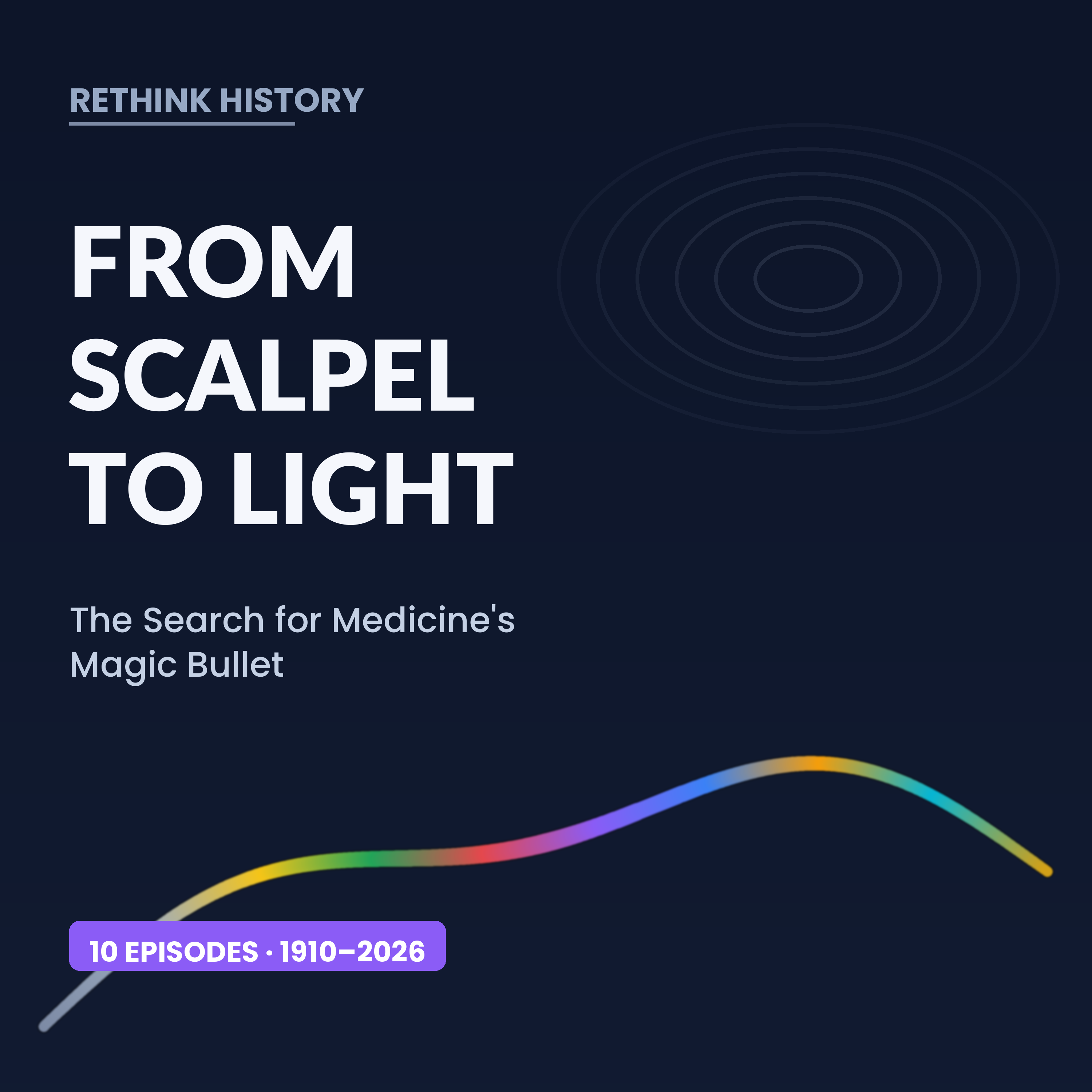
ReThink History: From Scalpel to Light
In 1910 Paul Ehrlich promised medicine a "magic bullet": a drug that would strike only the disease and leave the patient untouched. On 5 October 2026, the Nobel Prize in Physiology or Medicine went to Karl Deisseroth, Peter Hegemann and Georg Nagel for optogenetics. Their method uses a protein borrowed from green algae, together with pulses of light, to switch chosen cells on or off within a thousandth of a second. This ten-part series follows the century between those two moments through five tools for controlling the body: the knife, the electric current, the molecule, the virus, and finally light. Each tool aimed more precisely than the one before it. Each also promised more than it delivered, from the Nobel-winning lobotomy to thalidomide to the first death in a gene-therapy trial. Before light learned to command the body, it learned to read it. Episode 5 tells the story of the pulse oximeter on your fingertip, partly through the compiler's own work: as a Stanford anesthesia trainee, he gathered calibration data for Nellcor's first commercial oximeter. Episodes 1–4: the magic bullet, surgery, electricity, pharmacology Episode 5: reading the body with light Episodes 6–9: gene delivery, the discovery of optogenetics, what it revealed about the brain, and the first attempts to use it in patients Episode 10: closed loops and AI, and the question of whether a magic bullet ever existed. Smallpox, polio and Guinea worm were all beaten without one. History, not medical advice. Clinical-trial status is current as of October 2026. Researched and compiled by Nick Mackenzie. Narrated by AI from a sourced research dossier.
Listen on Apple Podcasts, Spotify, YouTube, or paste the RSS link into any podcast app.
Episodes
Ep 1: The Magic Bullet
Every physician shares one dream: a treatment that strikes the disease and spares the patient.
Ep 2: The Knife
Medicine's first instrument of control was the knife.
Ep 3: The Spark
Electricity is the body's own language, and medicine learned to speak it: from Galvani's frog legs to the first implanted pacemaker in Stockholm in 1958, the implantable defibrillator, the cochlear implant and deep brain stimulation for Parkinson's disease.
Ep 4: The Molecule
Drugs brought a new kind of precision: a molecule that fits one receptor like a key in a lock.
Ep 5: Reading the Body with Light
Before light could command a cell, it learned to read the body.
Ep 6: The Virus as Courier
A virus is a package of genetic instructions wrapped in protein.
Ep 7: The Light Switch
A single-celled green alga swims toward light using a protein that opens like a gate when light hits it.
Ep 8: What the Light Revealed
Optogenetics became the most powerful tool ever built for mapping the brain's wiring.
Ep 9: Light Enters the Clinic
On the day optogenetics won the Nobel Prize, not one optogenetic therapy was approved anywhere.
Ep 10: The Closed Loop
The series ends with its own thesis tested.
Explore further
Part of the listening path Inside American Medicine (stop 4 of 6) — next: The White Plague Returns.
 A Shot of Reason
 Wonder Drug? The GLP-1 Story
 Replacement Therapy
 The Invisible Bill